


The Spiritual Landscape of Ireland: Sacred Sites and Ancient Energy
Ireland is one of the most spiritually charged landscapes on earth. For thousands of years, the people who have lived here have understood the land itself as sacred — not merely as a backdrop to human life but as an active, living presence, shot through with energy, memory, and meaning. The evidence of this understanding is written into the landscape in stone: in passage tombs older than the pyramids, in sacred wells that have been visited for millennia, in mountain peaks that have drawn pilgrims since before recorded history.
Here is a guide to some of Ireland’s most significant sacred sites — and the ancient energy they carry.
Newgrange, County Meath
Newgrange is perhaps the most extraordinary sacred site in Ireland — a passage tomb built around 3200 BCE, making it older than Stonehenge and the Egyptian pyramids. At dawn on the winter solstice, a shaft of sunlight penetrates the passage and illuminates the inner chamber for approximately seventeen minutes — a feat of astronomical engineering that required extraordinary knowledge and intention.
The people who built Newgrange understood the movements of the heavens with a precision that still astonishes modern astronomers. They chose to mark the moment of maximum darkness — the winter solstice — with a monument that fills with light. The message encoded in stone is the same message that has sustained human beings through every dark season: the light returns. It always returns.
The Hill of Tara, County Meath
Tara was the ancient seat of the High Kings of Ireland — the symbolic and spiritual centre of the island for thousands of years. The landscape is rich with monuments: the Mound of the Hostages (a passage tomb aligned with the cross-quarter sunrises), the Rath of the Synods, the Forradh (the Royal Seat), and the Lia Fáil — the Stone of Destiny, said to cry out when touched by the rightful king of Ireland.
Tara is a place of extraordinary presence — a site where the layers of human spiritual activity over five thousand years have created something palpable in the landscape. To stand on the Hill of Tara on a clear day, with the plains of Meath spread out in every direction, is to feel the weight and the continuity of Irish spiritual history in a way that is difficult to articulate but impossible to miss.
Glendalough, County Wicklow
Glendalough — the Valley of the Two Lakes — was founded as a monastic settlement by St Kevin in the sixth century CE. Kevin was drawn to the valley by its extraordinary natural beauty and its quality of stillness — a place where the mountains, the lakes, and the ancient oak woodland created conditions of natural contemplation that he recognised as sacred.
The monastery he founded became one of the great centres of Irish Christianity — a place of learning, of art, and of spiritual formation that drew pilgrims from across Europe. The round tower, the cathedral, the churches, and the hermitage cells that remain are among the most beautiful early Christian monuments in the world. And the valley itself — the lakes, the woodland, the quality of light — retains the quality of stillness that drew Kevin here fifteen centuries ago.
Croagh Patrick, County Mayo
Croagh Patrick — the Reek — is Ireland’s holy mountain, rising 764 metres above Clew Bay on the west coast. It has been a place of pilgrimage since before recorded history: the mountain was sacred in the pre-Christian tradition, associated with the god Lugh and the festival of Lúnasa, and it was Christianised by St Patrick, who is said to have fasted on its summit for forty days.
Each year on Reek Sunday — the last Sunday of July — tens of thousands of pilgrims climb the mountain, many barefoot, in one of the largest and most ancient pilgrimage traditions in the world. The climb is demanding; the summit, on a clear day, is one of the most beautiful places in Ireland. And the sense of participating in a tradition that stretches back thousands of years is itself a form of spiritual experience.
The Skellig Islands, County Kerry
The Skellig Islands — Skellig Michael and Little Skellig — rise dramatically from the Atlantic Ocean twelve kilometres off the Kerry coast. Skellig Michael is home to one of the most extraordinary early Christian monastic settlements in the world: a community of monks who chose to live on a rock in the middle of the ocean, in conditions of extreme austerity, in pursuit of the closest possible encounter with God.
The beehive cells and oratories they built — dry-stone structures that have survived intact for over a thousand years — are a testament to both their engineering skill and their spiritual intensity. To visit Skellig Michael is to encounter a quality of dedication and of presence that is genuinely humbling.
The Sacred Wells of Ireland
Ireland has hundreds of sacred wells — springs and water sources that have been visited for healing, for blessing, and for prayer since before recorded history. The most famous is St Brigid’s Well at Kildare, associated with both the goddess Brigid and the Christian saint of the same name — a continuity that speaks to the deep layering of Irish spiritual tradition.
The practice of visiting a sacred well — walking the pattern (a prescribed circuit of prayer), tying a clootie (a strip of cloth representing a prayer or intention) to the tree beside the well, and drinking or bathing in the water — is one of the oldest and most enduring forms of Irish spiritual practice. It continues today at wells across the country.
Carrying the Landscape Into Your Practice
You do not need to visit these sites in person to connect with the energy they carry. The Irish landscape — its quality of light, its layered history, its understanding of the sacred as present in the ordinary — is available to all of us through intention, through prayer, and through the simple act of lighting a candle with awareness of the tradition it comes from.
Our archangel candles are made in Ireland, in the spirit of this long tradition of sacred practice:
- → Michael Candle — Protection & Courage
- → Raphael Candle — Healing & Restoration
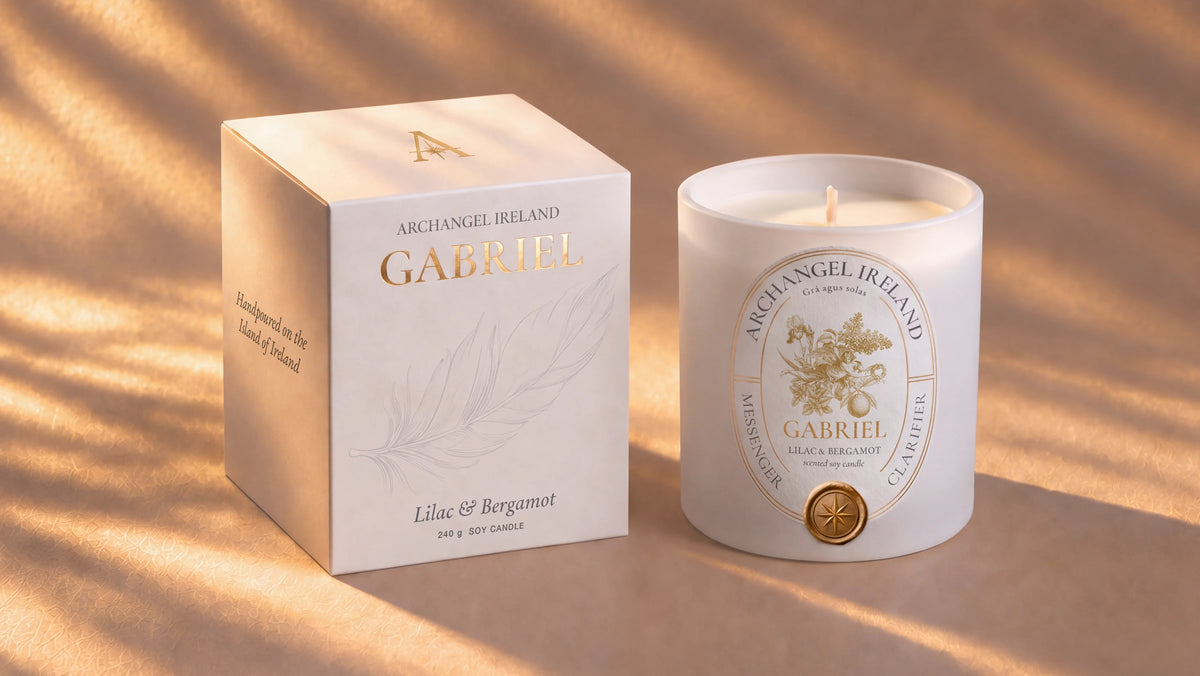
- → Gabriel Candle — Clarity & Communication
- → Uriel Candle — Wisdom & Illumination
For more on Irish spiritual tradition, read our guides to angels in Irish tradition, Samhain and the Celtic tradition of candlelight, and Imbolc: the Celtic festival of light.

Written by Gareth W

Leave a comment
This site is protected by hCaptcha and the hCaptcha Privacy Policy and Terms of Service apply.