


Angels in Irish Tradition: A Hidden History
Ireland has one of the richest and most distinctive relationships with the angelic world of any country on earth. From the earliest centuries of Irish Christianity through the great monastic tradition and into the living folk spirituality that persisted in rural communities well into the twentieth century, angels have been woven into the fabric of Irish spiritual life in ways that are both theologically sophisticated and deeply personal.
Here is the hidden history of angels in Ireland — a story that is inseparable from the story of Irish spirituality itself.
Angels in Early Irish Christianity
When Christianity came to Ireland in the fifth century, it encountered a culture already deeply attuned to the invisible world. The Celtic tradition had long understood the landscape as alive with spiritual presences — the sí (fairy mounds), the sacred wells, the thin places where the boundary between the human and the divine grew permeable. Christianity did not replace this sensibility; it absorbed and transformed it.
The result was a form of Christianity uniquely open to angelic encounter. The early Irish saints — Patrick, Brigid, Columba, Kevin — were understood to live in constant relationship with the angelic world. Angels appeared to them in visions, guided their journeys, protected them from danger, and carried their prayers to God. This was not considered extraordinary; it was simply the normal texture of a holy life.
Saint Patrick and the Angels
Patrick’s own account of his life — the Confessio — is filled with angelic encounters. It was an angel, he writes, who first told him to escape from slavery in Ireland and return to his homeland. It was an angel who later told him to return to Ireland as a missionary. Throughout his ministry, Patrick describes a relationship with the angelic world that is immediate, personal, and entirely matter-of-fact — as natural as a conversation with a trusted friend.
The angel most associated with Patrick is Victor — a figure who appears repeatedly in his writings and in later hagiography, described as Patrick’s personal angelic companion and guide. This relationship between a saint and a named personal angel is characteristic of early Irish spirituality — a tradition in which the angelic world was not distant and abstract but close, present, and intimately involved in the details of human life.
Saint Columba and the Angels of Iona
Columba — the great Irish monk who founded the monastery of Iona off the coast of Scotland in 563 CE — was said to see angels regularly. His biographer Adomnán describes numerous angelic encounters: angels appearing as columns of light, angels carrying the souls of the newly dead to heaven, angels protecting the monastery from spiritual attack.
Most movingly, Adomnán describes the night of Columba’s death: the entire island of Iona was said to be filled with angelic light, and the monks who witnessed it understood that a great company of angels had come to accompany their founder’s soul on its final journey.
The Thin Places: Angels and the Irish Landscape
One of the most distinctive features of Irish spirituality is the concept of thin places — locations where the boundary between the human and the divine is unusually permeable, where the sacred breaks through into the ordinary with particular ease. These thin places — sacred wells, ancient monastic sites, mountain peaks, island sanctuaries — were understood as places where angelic presence was especially accessible.
Croagh Patrick in County Mayo, Glendalough in County Wicklow, the Skellig islands off the Kerry coast, the Hill of Tara in County Meath — these are places where generations of Irish people have gone to pray, to seek healing, to encounter the sacred. They are places where the veil between worlds has always been understood to be thin — and where, in the Irish tradition, angels are particularly close.
Folk Angelology: Angels in Everyday Irish Life
Beyond the formal theology of the Church and the extraordinary experiences of the saints, angels were woven into the everyday spiritual life of ordinary Irish people in ways that persisted for centuries. Prayers to guardian angels were among the first prayers taught to children. The Lúírech Phádraig — St Patrick’s Breastplate — invokes angelic protection as naturally as it invokes the forces of nature. Deathbed prayers called on angels to accompany the dying soul; prayers at the beginning of a journey asked for angelic protection on the road.
This folk angelology — practical, personal, and deeply integrated into daily life — is one of the most beautiful expressions of Irish spirituality. It reflects a worldview in which the sacred is not confined to churches and formal occasions but is present in every moment, every journey, every threshold of human experience.
Archangel Ireland: Continuing the Tradition
At Archangel Ireland, our candles are made in the spirit of this long tradition — the understanding that archangel energy is not abstract or distant, but close, personal, and available to all of us in the ordinary moments of our lives.
- → Michael Candle — Protection & Courage
- → Raphael Candle — Healing & Restoration
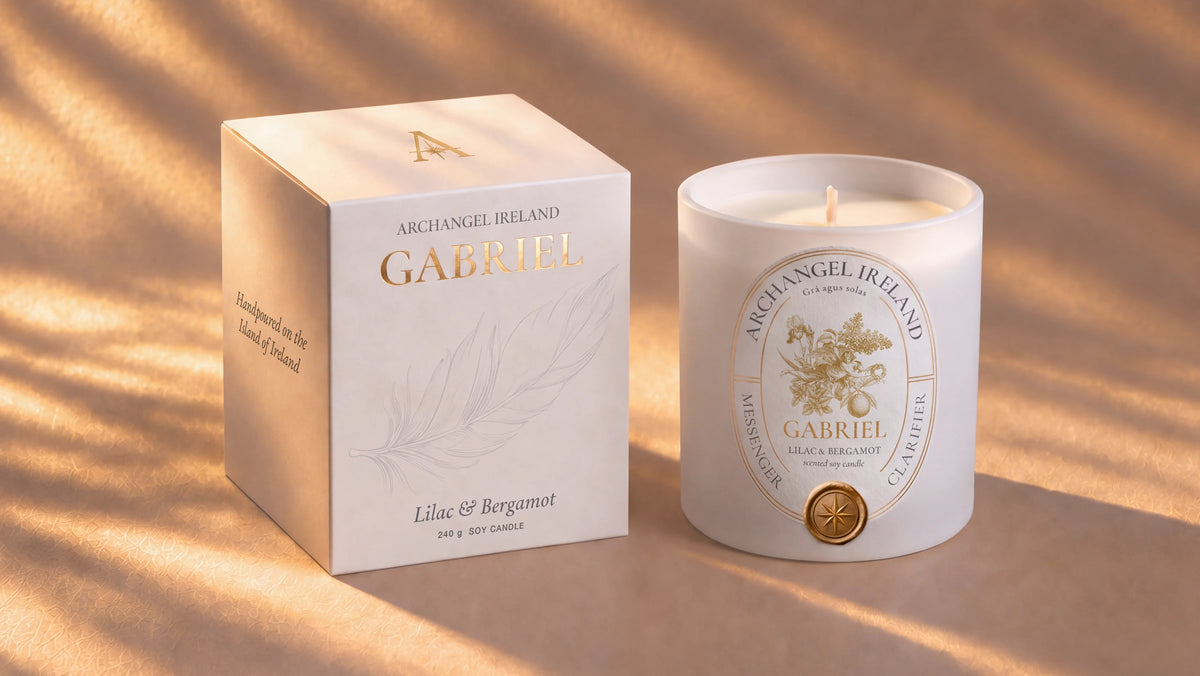
- → Gabriel Candle — Clarity & Communication
- → Uriel Candle — Wisdom & Illumination
For more on Irish spiritual tradition, read our guides to Samhain and the Celtic tradition of candlelight and the spiritual landscape of Ireland.

Written by Gareth W

Leave a comment
This site is protected by hCaptcha and the hCaptcha Privacy Policy and Terms of Service apply.