


The Summer Solstice in Irish Tradition
Around 21 June each year, the sun reaches its highest point in the sky and the day is at its longest. This is the summer solstice — the peak of light, the zenith of the solar year, the moment when the sun’s power is at its greatest before the slow, inevitable turn back toward darkness begins. In Ireland, this moment has been marked with fire, ceremony, and celebration for thousands of years.
The Summer Solstice in Ancient Ireland
The evidence of Ireland’s ancient relationship with the summer solstice is written into the landscape itself. Across the country, megalithic monuments — passage tombs, stone circles, standing stones — are aligned with the rising or setting sun at the solstice, demonstrating that the people who built them were sophisticated astronomers who understood the movements of the heavens and considered them worthy of monumental commemoration.
The Lios na Gráinne (Fort of the Sun) in County Limerick, the Drombeg stone circle in County Cork, and numerous other sites across the island are oriented toward the summer solstice sunrise or sunset — places where, on the longest day, the sun’s light enters the monument in a way that could only have been intentional.
At the Hill of Tara — the ancient seat of the High Kings of Ireland — the Mound of the Hostages passage tomb is aligned with the rising sun at the cross-quarter days, and the entire complex is understood to have been a centre of solar and seasonal ceremony for millennia.
Midsummer Fires
The most widespread Irish tradition associated with the summer solstice — and with the feast of St John the Baptist on 24 June, which absorbed many of the older solstice customs — was the lighting of bonfires. On Midsummer’s Eve, fires were lit on hilltops across Ireland, visible for miles in every direction, creating a network of light across the darkening landscape.
People leapt over the fires for luck and protection. Cattle were driven through the smoke for purification. Torches were lit from the communal fire and carried home to relight household hearths, bringing the blessing of the sacred flame into everyday life — the same practice observed at Bealtaine, and rooted in the same understanding of fire as a sacred, purifying, and connecting force.
In many parts of Ireland, this tradition of Midsummer bonfires survived well into the twentieth century, and in some communities it continues today.
St John’s Eve and the Christianisation of Midsummer
As with Samhain and Imbolc, the Christian tradition absorbed and reframed the older solstice customs rather than replacing them entirely. The feast of St John the Baptist — 24 June — fell close enough to the solstice to serve as its Christian counterpart, and the bonfires of Midsummer became St John’s fires, their ancient meaning layered with new significance.
This layering is characteristic of Irish spirituality — a capacity to hold the old and the new together, to find continuity between the pre-Christian and the Christian, and to honour the sacred in the landscape and the seasons regardless of the theological framework applied to it.
The Spiritual Meaning of the Summer Solstice
The summer solstice carries a paradox at its heart: it is the peak of light, and it is also the moment when the light begins to wane. The longest day is also the turning point — the moment after which the days grow shorter, the darkness gradually returns, and the year begins its slow arc toward winter.
This paradox is spiritually rich. It invites us to celebrate what is at its peak while holding the awareness that peaks are also turning points — that fullness contains within it the seed of the next emptying, and that this is not a tragedy but a rhythm. The solstice teaches us to be fully present in the moment of abundance, knowing it will not last — and trusting that what comes after has its own beauty.
How to Honour the Summer Solstice Today
- Rise for the sunrise — the solstice sunrise is one of the most beautiful of the year. If you can, be outside to watch it.
- Light a fire or candles at dusk — in the tradition of the Midsummer bonfires, light candles as the sun goes down on the longest day
- Spend the day outdoors — the solstice is a day to be in the light, in nature, in the fullness of the season
- Give thanks for abundance — what is at its peak in your life right now? What are you grateful for at this high point of the year?
- Set intentions for the second half of the year — the solstice is a natural midpoint; what do you want to bring to fruition before the year ends?
A Summer Solstice Candle Ritual
As the sun sets on the longest day, light a candle and sit quietly with these reflections:
I honour the light at its peak —
the abundance, the warmth, the fullness of this season.
I give thanks for what has grown and what is flourishing.
And as the light begins its gentle turning,
I trust the rhythm of the year
and carry this moment of fullness with me into what comes next.
Thank you.
- → Michael Candle — for strength and courage at the peak of the year
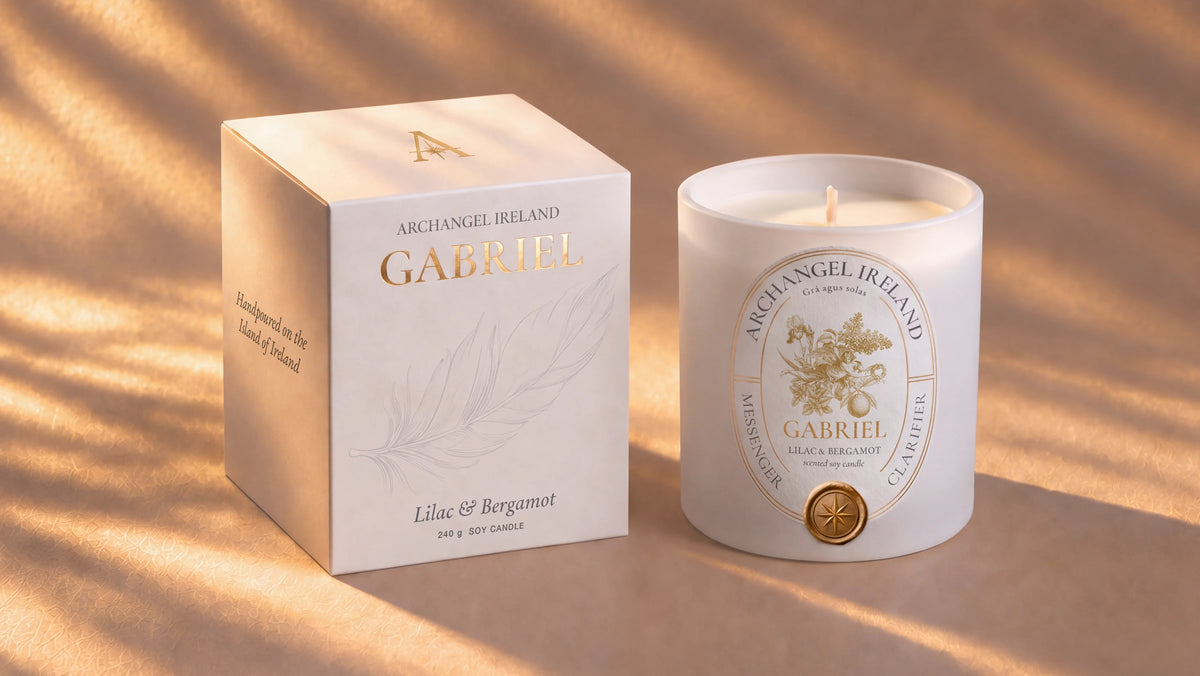
- → Gabriel Candle — for celebrating creative abundance and inspired expression
- → Raphael Candle — for gratitude and the joy of being fully alive
- → Uriel Candle — for wisdom and the perspective to appreciate the peak before it passes
For more on the Celtic seasonal calendar, read our guides to Samhain, Imbolc, Bealtaine, and Lúnasa.

Written by Gareth W


Leave a comment
This site is protected by hCaptcha and the hCaptcha Privacy Policy and Terms of Service apply.