


What Do Angels Look Like? Across Traditions and Time
Ask most people to picture an angel and they will describe something similar: a beautiful human figure, white-robed, with large feathered wings and perhaps a halo of golden light. This image is so familiar it has become almost universal — reproduced in art, film, greeting cards, and Christmas decorations across the world. But it is, in historical terms, a relatively recent invention. The angels described in scripture and ancient tradition are often something far stranger, far more vast, and far more awe-inspiring than the gentle figures of popular imagination.
Here is what angels actually look like — across the traditions that have described them.
Angels in the Hebrew Bible
The earliest descriptions of angels in the Hebrew scriptures are remarkably varied — and often startling. The word most commonly translated as “angel” in the Hebrew Bible is mal’akh, meaning simply “messenger” — and in many early accounts, these messengers appear as ordinary human beings, indistinguishable from people until they reveal their nature.
But alongside these human-appearing messengers are descriptions of beings of an entirely different order. The seraphim described in Isaiah 6 have six wings each: two to cover their faces, two to cover their feet, and two with which to fly. They cry out to one another in voices so powerful that the doorposts of the temple shake. The cherubim described in Ezekiel are four-faced creatures — with the faces of a human, a lion, an ox, and an eagle — with four wings, straight legs with hooves like calves, and hands beneath their wings. They move accompanied by wheels within wheels, covered in eyes, that move wherever the spirit moves them.
These are not gentle, reassuring figures. They are beings of overwhelming power and strangeness — which is why the first words spoken by an angel in scripture are almost always: “Do not be afraid.”
Angels in the New Testament
In the New Testament, angels appear more frequently in human form — though they are still described as radiant, luminous, and unmistakably other. The angel who appears at the tomb of Jesus is described as having an appearance “like lightning” and clothing “white as snow.” The guards who see him are so overwhelmed that they become “like dead men.”
The Book of Revelation returns to the more cosmic imagery of the Hebrew prophets — angels of enormous power, wrapped in clouds, with faces like the sun and legs like pillars of fire, holding open scrolls and sounding trumpets that shake the foundations of the world.
Angels in Islamic Tradition
In Islamic tradition, angels (mala’ika) are described as beings created from light — pure, luminous, and without the capacity for sin. They are understood to be vast in number and immense in power. Jibril (Gabriel), who brought the revelation of the Quran to the Prophet Muhammad, is described as having 600 wings that span the horizon. When Muhammad first encountered him, the experience was so overwhelming that he trembled and had to be comforted by his wife Khadijah.
Islamic tradition emphasises that angels have no gender, no physical needs, and no independent will — they exist entirely in service to God and carry out divine commands with perfect obedience.
The Winged Angel of Christian Art
The familiar image of the winged, robed angel that dominates Western art developed gradually through the early Christian centuries, drawing on both the winged figures of Greek and Roman art (Nike, the goddess of victory; the winged Eros) and the scriptural descriptions of seraphim and cherubim. By the Byzantine period, angels were consistently depicted with wings, halos, and flowing robes — an iconography that has remained remarkably stable for over a thousand years.
The Renaissance added beauty, grace, and human warmth to the angelic image — Fra Angelico, Raphael, and Botticelli created angels of extraordinary loveliness that shaped the popular imagination for centuries. The chubby, childlike putti — often mistaken for angels — are a Renaissance invention with no scriptural basis whatsoever.
What Angels Feel Like
Across traditions, those who describe encounters with angels speak less about what they saw and more about what they felt: an overwhelming sense of presence, of light, of love, of peace that surpassed understanding. Many describe a feeling of being known completely — seen to the core — and loved without condition.
This felt quality of angelic encounter — the warmth, the peace, the sense of being held — is perhaps more consistent across traditions than any visual description. It suggests that whatever angels are, their essential nature is experienced not through the eyes but through the heart.
Experience Archangel Energy for Yourself
Whatever form angels take, their energy is available to all of us. Our archangel candles are crafted to honour the distinct energy of each archangel — hand-poured in 100% natural soy wax, with fragrances chosen to reflect their unique qualities.
- → Michael Candle — Protection, courage, and strength
- → Raphael Candle — Healing, comfort, and restoration
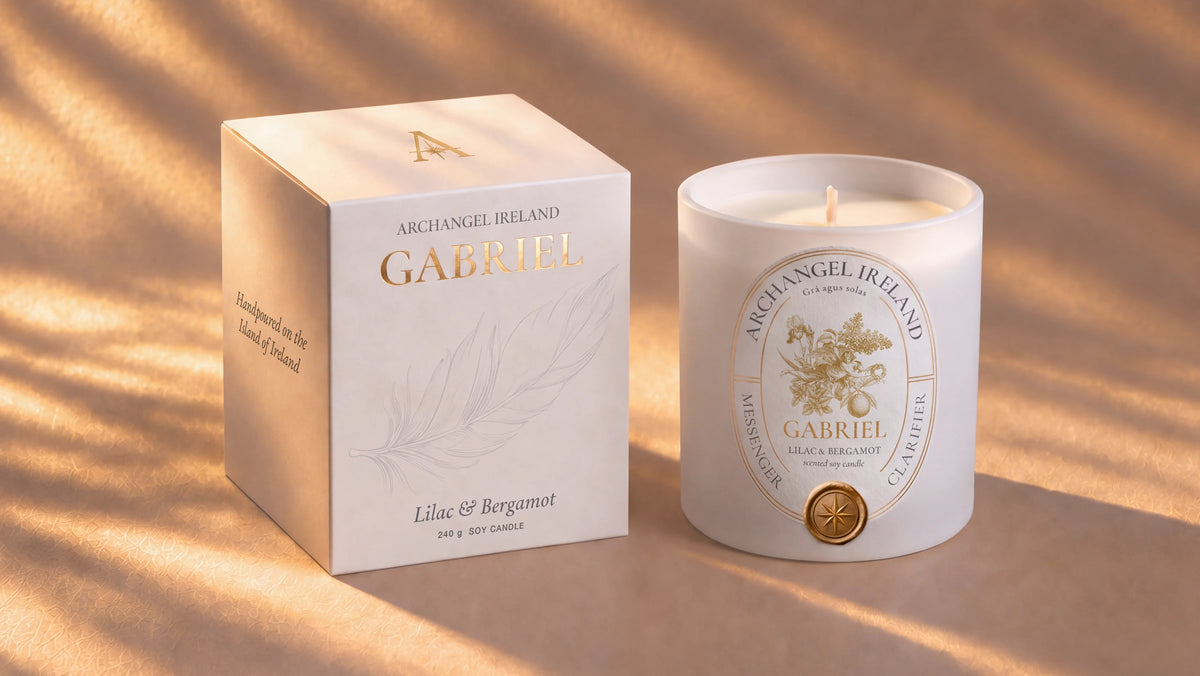
- → Gabriel Candle — Clarity, creativity, and communication
- → Uriel Candle — Wisdom, illumination, and inner knowing
To learn more about the archangels and how to work with their energy, read our guide to the seven archangels and what they do, or our guide to signs your guardian angel is near.

Written by Gareth W


Leave a comment
This site is protected by hCaptcha and the hCaptcha Privacy Policy and Terms of Service apply.