


The History of Candles in Spiritual Practice
The candle is one of the oldest spiritual tools in human history. Long before electricity, long before glass windows, long before the modern world made light a matter of flicking a switch, fire was sacred — a gift, a mystery, and a bridge between the human and the divine. The candle, as a controlled and portable form of that fire, has been at the heart of spiritual practice across virtually every culture and tradition for thousands of years.
Here is the story of how candles came to hold such a central place in the human spiritual imagination — and why they still do.
The Earliest Sacred Fires
The use of fire in ritual predates recorded history. Archaeological evidence suggests that early humans used fire not only for warmth and cooking but for ceremony — gathering around flames in ways that appear to have had social and spiritual significance. Fire was understood as alive, as powerful, and as connected to forces beyond the human world.
The earliest candles — rushes soaked in animal fat, or wicks dipped in tallow — appear in ancient Egypt and Rome, where they were used in religious ceremonies and to light temples. The Egyptians used candles in their worship of the sun god Ra, and in rituals associated with the dead. The Romans used them in the cult of the Vestal Virgins, whose sacred flame was never allowed to go out.
Candles in Judaism
In Jewish tradition, candles hold a central and deeply meaningful place. The Shabbat candles, lit at sundown on Friday evening, mark the beginning of the day of rest and are one of the most widely observed Jewish rituals in the world. The Hanukkah menorah — the chanukiah — commemorates the miracle of the oil that burned for eight days in the rededicated Temple in Jerusalem. The Yahrzeit candle burns for twenty-four hours on the anniversary of a loved one’s death, keeping their memory alive in light.
In each of these practices, the candle is not merely decorative — it is the ritual itself. The lighting is the act of faith.
Candles in Christianity
Christianity adopted candles early and thoroughly. In the early Church, candles were used in the catacombs — both for practical light and as a symbol of Christ as the light of the world. The Paschal candle, lit at the Easter Vigil, represents the risen Christ and is one of the most powerful symbols in the Christian liturgical year.
Votive candles — small candles lit in prayer before an image of Christ, Mary, or a saint — became one of the most universal expressions of Christian devotion. The practice of lighting a candle for someone — for their healing, their safety, their soul — is one of the oldest and most instinctive forms of intercessory prayer.
In Ireland, the tradition of placing a candle in the window at Christmas — to welcome the Holy Family and light the way for Mary and Joseph — persisted in rural communities well into the twentieth century. It is a tradition with roots that go deeper than Christianity, into the ancient Celtic practice of using light to mark the threshold between worlds.
Candles in Buddhism and Hinduism
In Buddhist practice, candles (alongside incense and flowers) are one of the three traditional offerings made at shrines and temples. The flame represents the light of the Buddha’s teaching — wisdom that dispels the darkness of ignorance. Lighting a candle is an act of devotion and a reminder of the practitioner’s own aspiration toward enlightenment.
In Hinduism, the ritual of aarti — the waving of a flame before a deity — is one of the most central acts of worship. The flame is understood as the divine light itself, and the act of offering it and receiving its blessing is a direct encounter with the sacred. Diyas — small clay lamps filled with oil — are lit in their millions at Diwali, the festival of light, in celebration of the victory of light over darkness.
Candles in Celtic and Pagan Tradition
In the Celtic world, fire was one of the most sacred forces in existence. The great seasonal festivals — Samhain, Imbolc, Bealtaine, and Lúnasa — were all marked with fire: bonfires on hilltops, flames in windows, embers carried from communal fires to relight household hearths. Fire was purifying, protective, and connective — a way of participating in the energy of the season and calling in its blessings.
The candle, as a domestic form of that sacred fire, carried the same significance into the home. A candle in the window was a beacon, a welcome, and a protection. A candle lit with intention was a prayer made visible.
Why Candles Still Matter
In an age of electric light, the candle has lost none of its power. If anything, it has gained a new significance — precisely because it is no longer necessary. When you light a candle today, you are making a choice. You are stepping out of the ambient brightness of modern life and into something older, quieter, and more intentional.
The flame still does what it has always done: it focuses attention, marks a threshold, and creates a quality of presence that electric light simply cannot replicate. It connects you — whether you are conscious of it or not — to every human being who has ever sat before a flame and felt, in that moment, that they were not entirely alone.
Continuing the Tradition
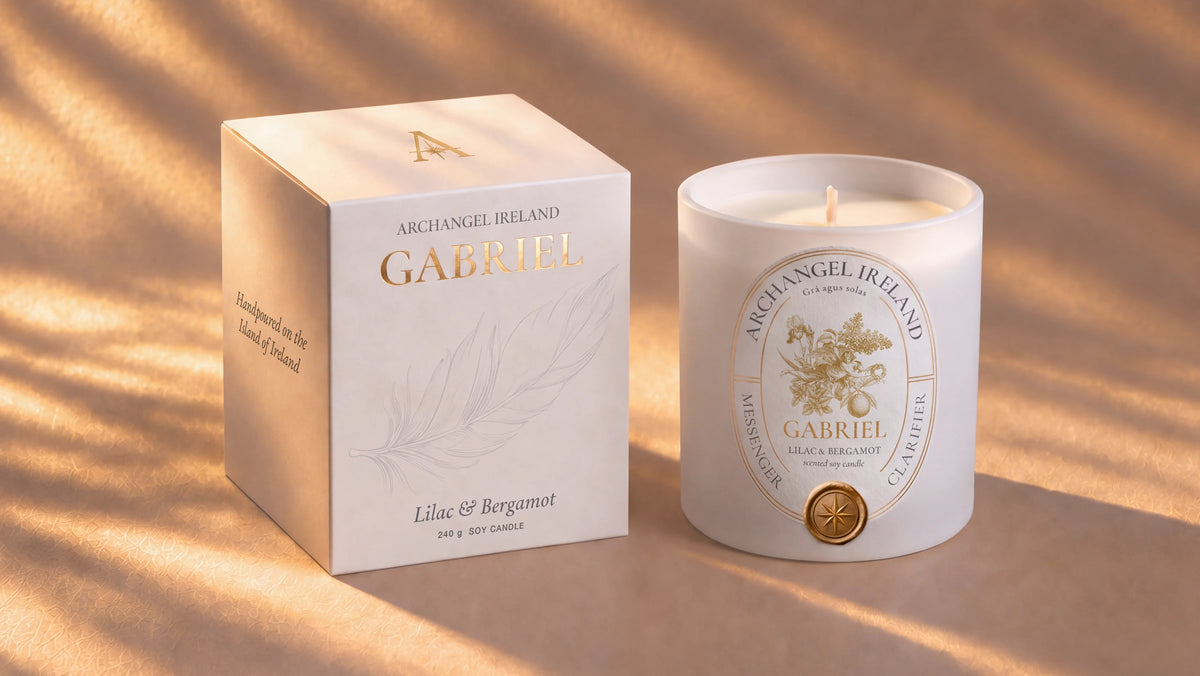
At Archangel Ireland, our candles are made to be used with intention — as tools for prayer, ritual, meditation, and the marking of what matters. Each one is hand-poured in 100% natural soy wax, with a fragrance chosen to complement the energy of its archangel.
- → Michael Candle — Protection & Courage
- → Raphael Candle — Healing & Renewal
- → Gabriel Candle — Clarity & Communication
- → Uriel Candle — Wisdom & Illumination
To learn how to use a candle with intention in your own practice, read our guide to creating a candle ritual with archangel energy.

Written by Gareth W


Leave a comment
This site is protected by hCaptcha and the hCaptcha Privacy Policy and Terms of Service apply.